ABCDFGHIJKLMNOQTVWXYZ
2. What is ART FOR HUMAN?
Only a life lived for the service of others is worth living
ー Albert Einstein
It is said that the world is made up of stories. "Why a story?”, says Tracy Chevalier [19], "because the world is kind of a crazy, chaotic place, and sometimes stories, we're trying to make sense of the world a little bit, trying to bring some order to it." There are two main types of stories. Myth and history. Myth is a story of the gods, and history is a story of human beings. Myths are told with the gods at the center; history is told with humans at the center. This view of the world with humans at the center is called anthropocentrism. This is a trend, especially since the modern era and art since the modern era based on anthropocentrism and history. We refer to this type of art as ART FOR HUMAN.
ART FOR HUMAN is primarily concerned with political, economic, and social systems. Who, when, where, what, and how does it? What impact has it had? This series of movements take place within the human-centered world. The aforementioned Manet also belongs to ART FOR HUMAN. The artist Manet started to paint The Luncheon on the Grass in Paris in 1862. The painting overturned the previous values and became a scandal in 1963. As a result, Manet's The Luncheon on the Grass far surpassed the completely new historical trend of modern painting and its market value (considering the facts that Yue Minjun's The Lunch on the Grass sold for $1.5 million in 2013[20], and Manet's Spring sold for $65.1 million in 2017[21], it is forecasted higher than the two). This trend became art history, which was passed down to future generations, and subsequent art developed under its influence. Art historians often classify the period after Manet as "modern art" and the period after Duchamp as "contemporary art. However, these two may belong to a larger category, ART FOR HUMAN in the future (pre-modern art may become ART FOR GOD or ART FOR KING). From this perspective, we will look at ART FOR HUMAN.
First, we will focus on Chris Burden, an artist best known for his film Shoot (1971), in which he is shot with a rifle.
|
Conflicts between Humanity and the Environment
Chris Burden, Samson (1985)
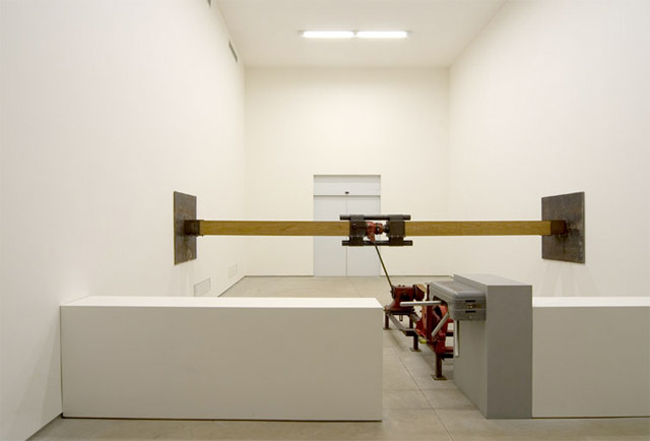
Samson, 1985, by Chris Burden
https://www.zinzin.com/observations/2012/like-a-glacier-samson-1981-by-chris-burden/
This is a work in which two pillars in the center of the venue gradually push the walls on both sides as people pass through a rotating arm gate in the front. The more people enter, the more pressure is exerted on the walls, which are eventually destroyed. As art has become popularized, it has become accessible to a wider audience. In general, the industry is revitalized when people who were once uninvolved become involved. With this popularization, however, the whisper of "art abuse” happens (Museum Fatigue in 1916 [22] or "Art Fair Fatigue" is often referred especially in the 2010s, as "art fair fatigue". Jax Barzon, in his 1975 book "The Use and Abuse of Art," states that "these days anything intended to be seen or heard is displayed only in the sense of being understood casually” [23]). The installation in the museum can be seen as an "institutional critique" of the museum, in which the increase in visitors leads to its demise.
Beyond criticism of the system of art, Samson also points to the drastic changes in the global environment caused by population growth, which can be seen as an issue of conflict (confrontation, clash, conflict, and tension) between humanity and the environment. It can also be seen as a wake-up call to progressivism that the more people increase, the harsher the environment will become. Considering the size of this gate, one can see that such a point of view is directed at humans, not dogs, cats, giraffes, or whales. Will the arm gate in Samson be a "gas pedal" or a "brake"? The choice is left to the visitor in front of this work.
|
Criticality of ntervention and Intolerance
Signe Pierce and Allie Coates, American Reflex (2015)
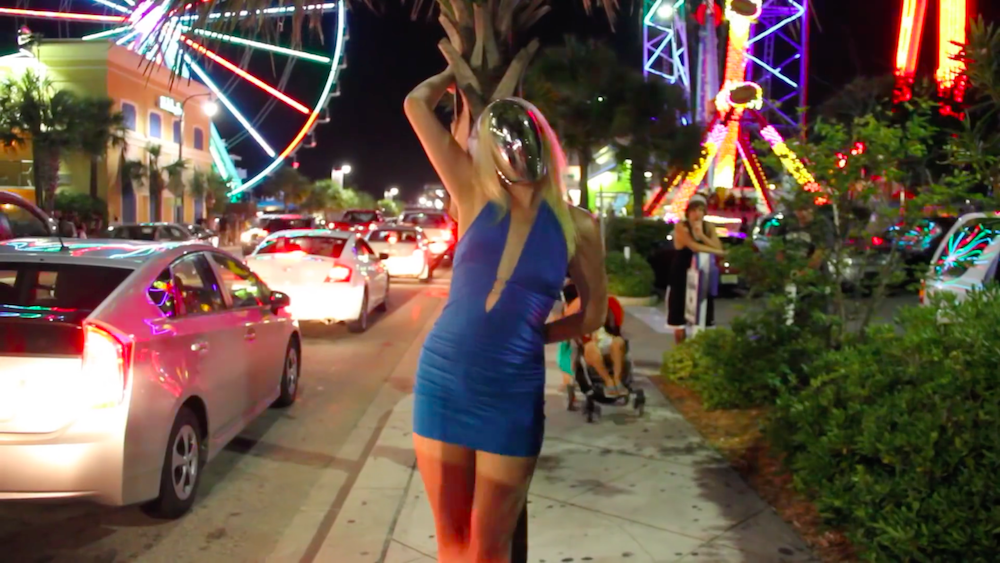
AMERICAN REFLEXXX, 2015 by Signe Pierce, Alli Coates
http://www.americanreflexxx.com
This is a work in which the provocative and enigmatic figure of Signe Pies walks through downtown Myrtle Beach, South Carolina (a "thoroughly conservative” [24] city with "a church on every street corner and a strip club on every other street corner” [25]). It was done in 2013, and in 2015 it was published on Youtube (over 1.7 million views as of 2019) and has generated much discussion. Ally Coates states. "Making art in NYC for NYC sometimes felt like preaching to the choir. So I wanted to get out of that resonance room. We have made several video art pieces that deal with being a woman and stereotypes, and we wanted to bring those themes into the real world.” [26] This intervention, however, was met with intolerance and even violence from those "outside of NYC.”
To begin with, the reactions to art done in a tolerant art world and art done in an intolerant real world are different. Constructive discussions in the former and unconstructive attitudes in the latter (attitudes toward the 1974 Soviet-era "Bulldozer Exhibition" [27], attitudes toward Anish Kapoor's work exhibited at the Palace of Versailles in 2015 [28], the 2017 Documenta presentation at the Attitudes toward the work of Aboubaca Fofona [29], among others) will be employed. The assumption that if the people on the ground in American Reflex had an ARTMIND, it would not have resulted in the use of force is merely an argument for the former. The latter had the latter's mindset and attitude to make that claim. That is the world. Kitaro Nishida states this. "In dialectics, conflict is synthesis, synthesis is conflict, and there is no synthesis without conflict, but there is also no conflict without synthesis. (omission) In the absolutely contradictory and self-identical present, in which the infinite past and the infinite future are bound together in mutual negation, it can be said to be ideational. (omission) Synthesis is not synthesis that denies opposition. Therefore, it is also a contradictory self-identity, moving in a self-contradictory way." [30] The criticality of intervention and intolerance is ubiquitous. This criticality is the yin-yang of ancient Chinese thought itself, and it is perhaps this that should be taken as the absolute contradictory self-identity.
|
The end of the world released by lavender
Martin Roth , In May 2017 I cultivated a piece of land in Midtown Manhattan nurtured by tweets (2017)
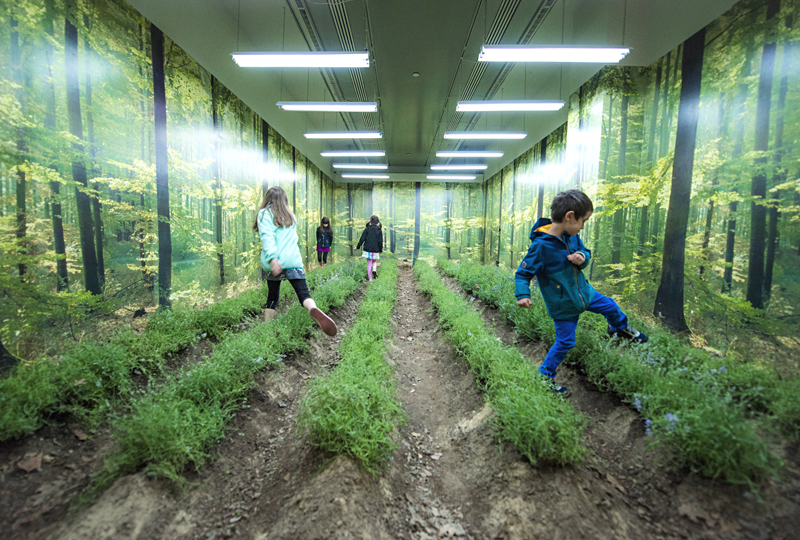
In May 2017 I cultivated a piece of land in Midtown Manhattan nurtured by tweets, 2017 by Martin Roth
http://martinroth.at/en/i-cultivated-a-piece-of-land-in-midtown-manhattan-nurtured-by-tweets/
This is a work in which 7 tons of soil is placed inside an exhibition venue near Trump Tower in New York City to grow 200 lavender plants (the lights in the hall and Twitter are linked by a single-board computer, Raspberry Pi). The system works by increasing the number of tweets (including retweets) by people who make politically conservative policies (such as @POTUS and @realDonaldTrump), which increases the intensity of the plant lights and encourages the lavenders to grow. The fact that lavender, which is used as an anti-anxiety agent, grows more is an anti-illumination of the real world, where social anxiety is on the rise. Moreover, its cryptic title reads like a historical record intended to be deciphered in the future (in all of Martin Ross' works, the title includes a description of the activities performed at the time, as well as the year and month of that time. Many of them incorporate non-human animals, plants, etc).
Claire Voon writes at the beginning of her text contributed to HYPERALLERGIC [31] that "Something very strange is currently growing in Midtown Manhattan. And the windowless, concrete space is also claustrophobic and reminds of a doomsday bunker." Was there ever such a lavender on earth? What does the end of the world that this exceptional and heterogeneous lavender releases have in store for us today?
This is my review of ART FOR HUMAN. The overall impression you may have had is that it is somewhat unsettling (perhaps that unsettledness is a reflection of contemporary society. The disquiet may reflect contemporary society.) Is ART FOR HUMAN also art in a world that cannot be at peace?
Next, let us look at ARTMIND from the perspective of ART AFTER HUMAN.
[19] https://www.ted.com/talks/tracy_chevalier_finding_the_story_inside_the_painting
[20] https://jingdaily.com/chinese-contemporary-prices-soar-at-christies-hong-kong/
[21] https://news.artnet.com/market/65-million-manet-leads-at-christies-165-million-imp-mod-sale-155456
[22] Gilman, Benjamin Ives, Museum Fatigue, The Scientific Monthly Vol. 2, No. 1 (Boston, American
Association for the Advancement of Science, 1916).
[23] Jacques Barzun, The Use and Abuse of Art (Prinston: Princeton University Press, 1974).
[24] [25] [26] http://www.artnews.com/2015/05/04/we-didnt-set-out-to-make-a-piece-about-
dehumanization-mob-mentality-or-violence-alli-coates-and-signe-pierce-talk-american- reflexxx/
[27] https://www.nytimes.com/1974/09/16/archives/russians-disrupt-modern-art-show-with-bulldozers-
unofficial-outside.html
[28] https://www.theguardian.com/world/2015/sep/07/anish-kapoor-queens-vagina-sculpture-at-versailles-
vandalised-again
[29] https://www.artforum.com/news/artist-s-studio-vandalized-by-animal-rights-group-angered-by-
documenta-14-work-68930
[30] 西田幾多郎 (1939) 『哲学論文集第三』岩波書店
[31] https://hyperallergic.com/379626/a-field-of-lavender-nourished-by-trumps-tweets/
|
NEXT
3. What is ART AFTER HUMAN?
PREVIOUS
1. What is ARTMIND?