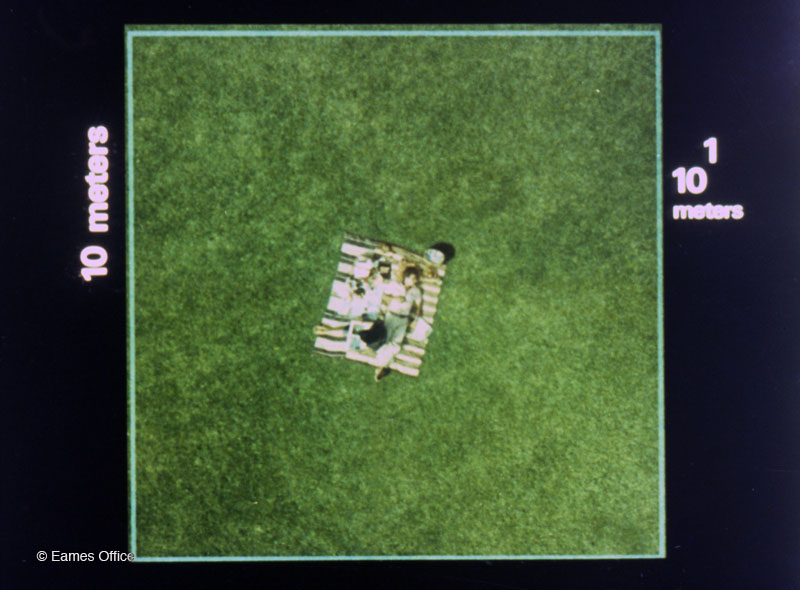
Where is a good place for art?
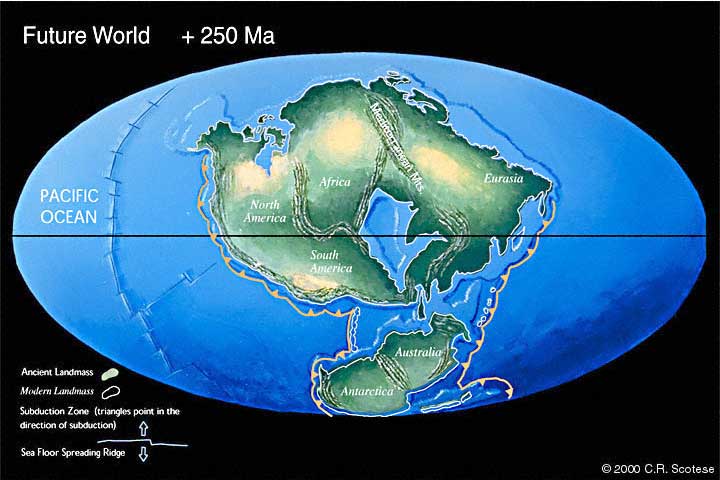
Pangea Ultima, 2000 by Christopher Scotese
http://www.scotese.com/future2.htm
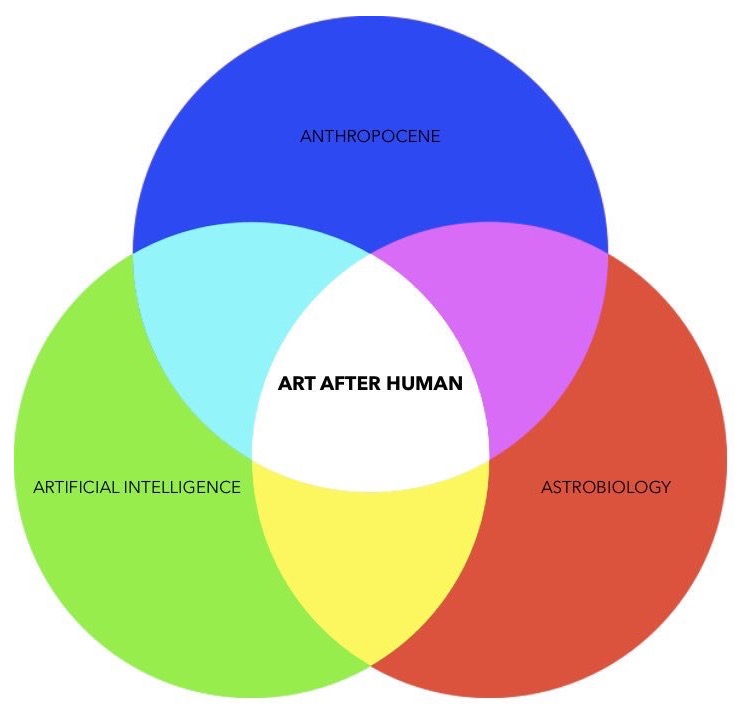
ART AFTER HUMAN is formed by synthesizing the above arguments. Viewing the world and art in this way raises the question of whether the earth is the best place for art in the first place.
Here, we will take up the concept of "A Bad Place" by Noi Sawaragi. In Shin Bijutsu Ron (Art Theory of the Earthquake) [39], he states: "In this place, the Axis, before and after the minimum necessary to make history work, is malfunctioning by the oblivion of the memory of the repeated disaster." "The situation that the Rias Ark Museum of Art faced is not an event unique to the museum, but a crisis that could have occurred at any time when the artificial system of the museum, which was born in the local region of Western Europe, is confronted with the more universal unexpectedness of the earth. A Japanese archipelago is a bad place itself, where multiple plates have been jostling unlike any other place on earth and rubbing against each other directly under the ground, creating countless active faults, which have repeatedly triggered huge earthquakes at almost regular intervals, sometimes triggering huge tsunami waves, and volcanoes formed by these tectonic movements have continuously caused massive explosions. In this point, the Japanese archipelago is nothing but a singularity in which all the "unexpected" in the earth's atmosphere is turned inside out into the “expected”. At the same time, from a geological perspective, such a singularity could be the true nature of the earth.”
300 million years ago, the Earth was one continuous continent called Pangaea. Later, plate tectonics formed the separate continents we see today, and as is well known, active faults are still moving. In 2000, Christopher Skotese predicted that in 250 million years, the Earth will again become one supercontinent, "Pangaea Ultima” (see figure above) [40] (the continents will collide with each other, the coastal areas will rise as huge mountains due to the collision, and the central part of the continent will become desert).
The earth may be “a bad place" for art in the first place. Art has the aspect of being created and preserved for others in the future. Based on the above sense of time, how many years into the future can we call it art? Is art something that exists only on the earth as software by LIFE 2.0? Or is there art in other dimensions as depicted in the movie Interstellar? Where is a good place for art? How does art accept this situation and how does it respond to it? Is ART AFTER HUMAN one of them?
First, let us look at the artist On Kawahara, who tackled the space-time rift.
|
Time Beyond the Human Scale
On Kawahara, One Million Years (1970-1998)
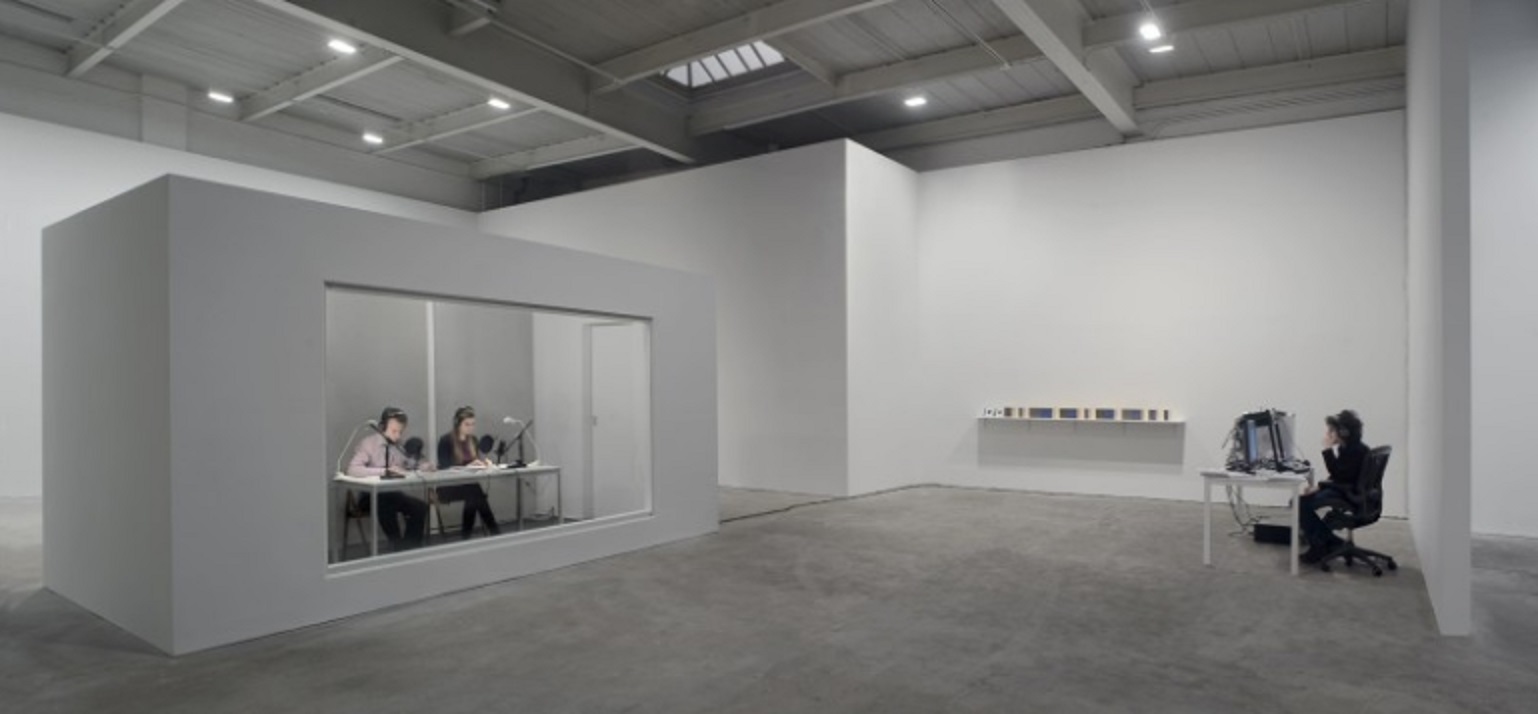
One Million Years, 1980-1988 by On Kawara
Installation view, On Kawara: One Million Years, David Zwirner, New York, 2009
Courtesy David Zwirner, New York/London. Photo: Cathy Carver.
https://www.davidzwirner.com/exhibitions/one-million-years
This is a total of 24 volumes marked with year numbers; each page contains 500 years, and each volume contains 2000 pages, for a total of 2 million years. The "Past Edition" covers one million years before 1969 AD, and the "Future Edition" covers one million years after 1999 AD. The Past Edition was produced from 1970-71, and the Future Edition from 1980-98. Each is subtitled "For All That Lived and Died" for the former and "For the Last Things" for the latter (as shown above, live recordings of each year's reading have been made at several locations since 1993). 1 million years is time beyond the human scale. It is unlikely that any of us will ever actually experience that overwhelming passage of time. The most peculiar aspect of this work is that the 19 years from 1970 to 1998 are blank. This 19-year void, sandwiched between a total of 20,000 years, holds a remarkable and perplexing mystery. Even stranger, the 2015 retrospective of Kawahara's work, SILENCE, at the Guggenheim Museum, did not include a single photograph of Kawahara's own face. Normally, a retrospective exhibition would chronicle the artist's life story, but there was none to be found. The biography is also extremely brief, with only a backward-facing figure at the end of the catalog [41] (which further deepens our knowledge of the unknown by Kawahara).
DNA as Art Form
Eduardo Kac, Genesis (1999)
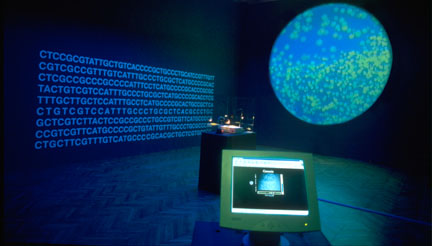
GENESIS, 1999 by Eduardo Kac
http://www.ekac.org/geninfo.html
This is a DNA-based work. First, a portion of the Bible is converted from Morse code to DNA base pairs, which are then implanted into bacteria. After the exhibition is over, the DNA is extracted from the bacteria and converted back into text. Eduard Kac, who combined the biotechnology of genetic recombination with art, said, "In the nineteenth century the comparison made by Champollion based on the three languages of the Rosetta Stone (Greek, demotic script, hieroglyphs) was the key to understanding the past. Today the triple system of Genesis (natural language, DNA code, binary logic) is the key to understanding the future.” [42] Currently, "DNA storage" is in the spotlight; in 2015, Nick Goldman told the Davos Forum, "DNA we are storing information about is a digital storage medium" [43]. Compared to stone, paper, DVDs, and hard disks, DNA is considered the most stable storage medium. DNA may go beyond the human scale as a medium that surpasses the Anthropocene. For example, the next painting could be DNA. If the DNA of a particular organism is scanned with a specialized device, we may be able to see Manet's "The Luncheon on the Grass". Art left behind only in the DNA of amur lemmings in the far north may be discovered by someone 200 million years from now. They may not be Homo sapiens. Citing bioengineering, cyborg engineering, and non-organic bioengineering, Harari says, "Too much modification of Homo sapiens may cause us to no longer be Homo sapiens."[44]
|
Near future where androids will share it
Katsu, "Android Selfie" (2014)
Selfie: Feng Shui 3, 2014 by Katsu
http://theholenyc.com/2015/01/02/katsu/
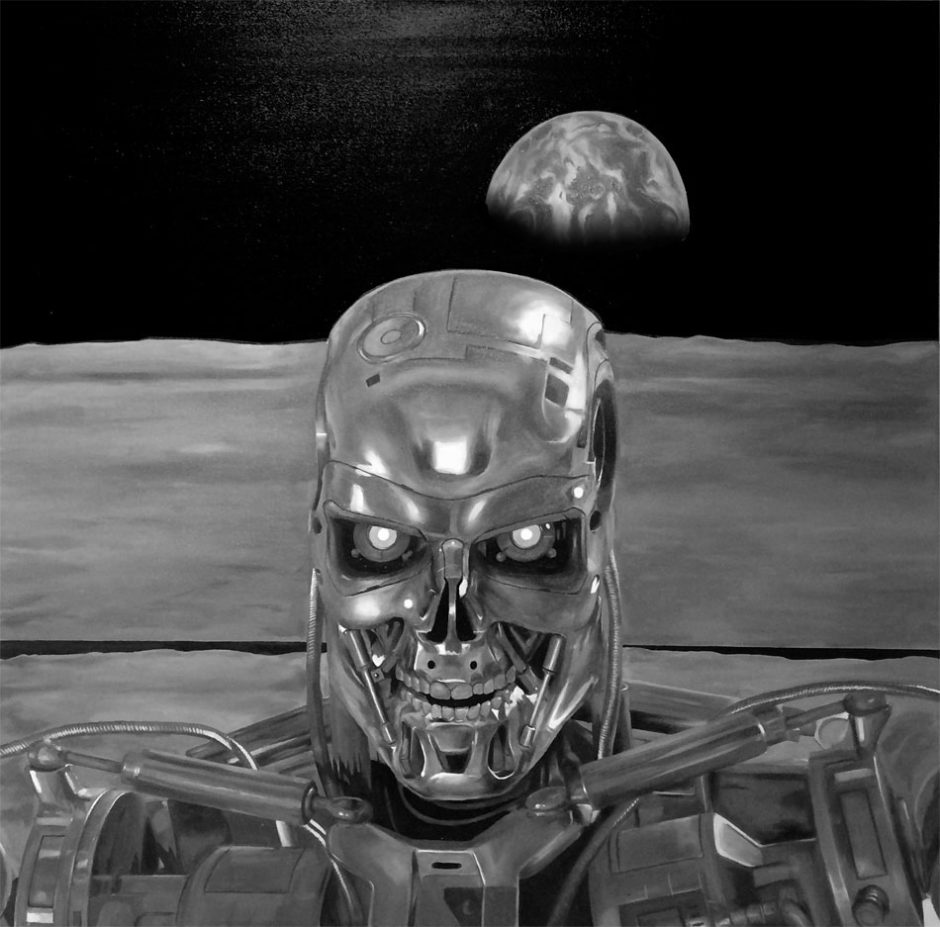
This work depicts a scene of an android taking a selfie. The press release [45] for the exhibition REMEMBER THE FUTURE, in which this work was shown, spells out. "One final body of work to note are KATSU’s “Android Selfies” where he paints in monochrome oil artificial intelligence taking selfies at global tourist destinations. This triptych is perhaps a culmination of the themes the exhibition explores, such as, what are all the computers going to do with themselves after humanity is gone? Will they reflect on the odd things we did, will they find meaning in them? All works in the show, in a way, could be artworks generated by an artificial intelligence, robots teaching themselves about humanity." Certainly, we do not know if AI will behave like humans. No one knows yet whether it will want to take a picture in the same place in the not-too-distant future when a conscious android sees this painting or whether it will think it is uncool, or even puzzling. Art is sometimes called "visual text," but we don't even know if their language and art are compatible. It may be deciphered once it is converted to binary data. It might be possible to "appreciate" it only by scanning the DNA of the Tasmanian wombat in which the painting's data is embedded. These assumptions may seem wildly improbable at this stage, but all possibilities remain in the future.
|
Art by AI
Sam Hains, Zero Likes (2017)
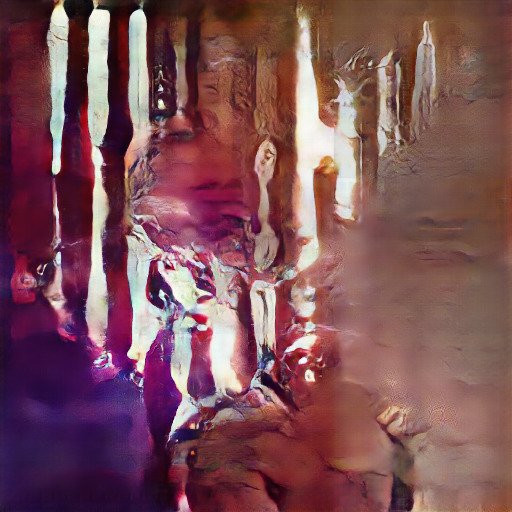
ZELO LIKES (People sitting on the backs of elephants), 2017 by Sam Hains
http://samhains.com/zero-likes
This is an AI-Generated Art. It is automatically produced, including its title, by an AI trained to respond to over 100,000 posts on Instagram with zero likes. Sam Haynes sees this as "a meditation on the aesthetics of nothingness" [46], "a generative, machine learning project exploring the aesthetics of the neglected, negative spaces of the internet.” [47] Like other fiefdoms, AI is transforming the art world: in 2018, the first AI work ever to be auctioned sold for approximately $48 million at Christie's, sparking a debate that it was "record can distort history" [48] and "attention will be drawn to actual legitimate artists working with AI". This is "the hope of the entire AI artist community" [49]. In 2006, Instagram made the following announcement. 'You might be surprised to learn that people miss, on average, 70% of their timelines. (omission) To improve your experience, your timeline will soon be directed to show the moments we believe will be of most interest to you" [50]. Since then, Instagram has offered an "algorithmic experience that is uniquely yours" (more cat posts for cat lovers and more parkour posts for parkour lovers). Zero Likes, on the other hand, offers us a different kind of "AI experience of exception" than Instagram. The external accumulation of images, excluded from the "like" system, has been introduced into the art system and may prompt a shift in subjectivity in the future. One of these is not LIFE 2.0 art, where humans use AI, but LIFE 3.0 art, where AI uses AI.
|
Art in Space
Trevor Paglen, The Last Pictures (2012-)
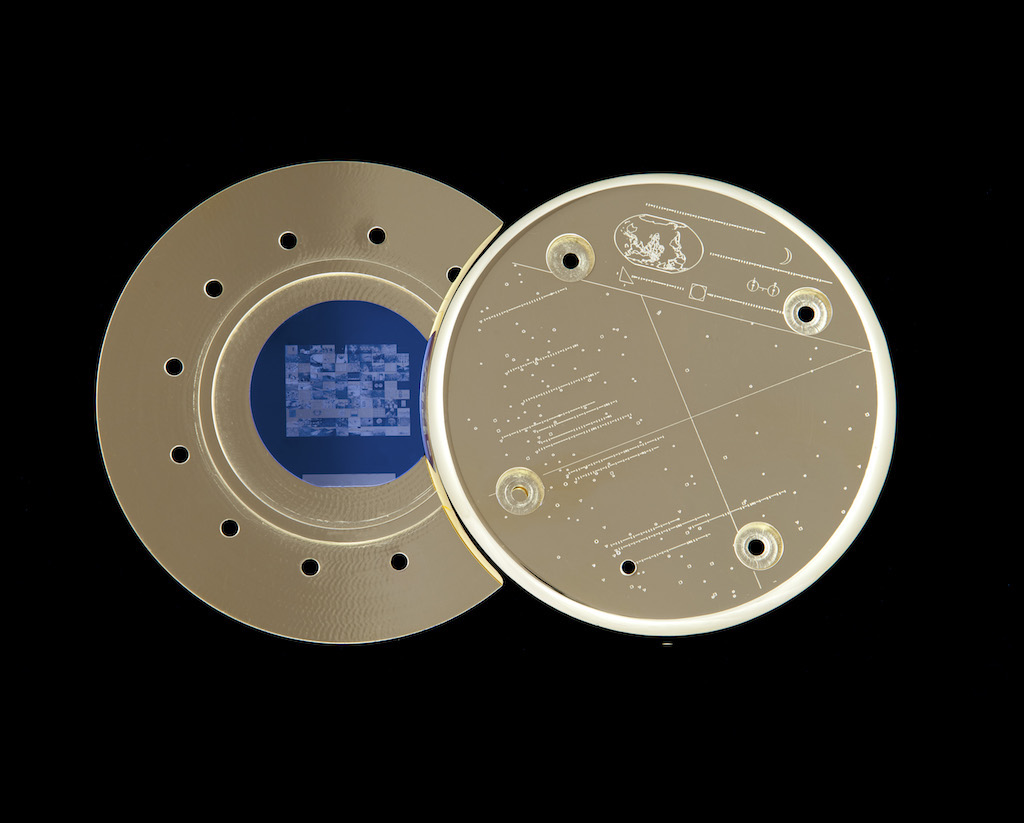
The Last Pictures, 2012- by Trevor Paglen
Trevor Paglen, The Last Pictures and the Gold Artifact, 2013, etched gold plated disk and HD video.
http://www.artnews.com/2018/08/24/archives-trevor-paglen-launches-photographs-space-2012/
This is a work of art consisting of 100 photographs that are supposed to exist in space for approximately billions of years. Those black-and-white photos are written on silicon chips and placed inside a gold-plated case. The case was mounted on the EchoStar XVI satellite, which was launched from the Baikonur Cosmodrome in Kazakhstan on November 20, 2012, and is still orbiting the Earth. The book The Last Pictures [51] opens with the following statement. "Human civilizations' longest lasting artifacts are not the great Pyramids of Giza, nor the cave paintings at Lascaux, but the satellites that circle our planet." And in the epilogue, Deep Future, Trevor Paglen writes, "Without question, human civilizations will not last forever. Sooner or later, Homo sapiens will join the ranks of the vast majority of species that have inhabited the earth are now extinct." And he quotes the American Museum of Natural History article in 1998, "we are in the midst of a mass extinction of living things" and that "this mass extinction is the fastest in Earth's 4.5-billion -year history ... this loss of species will pose a major threat to human existence in the next century." And he says, "In a hundred trillion years, star formation will begin to cease throughout the universe. One by one, the points of light that dot the cosmos will go black until they are all gone. By this time a wayward neutron star or pulsar, will have come perilously close to what was once the sun, sending a great wave through spacetime, spinning EchoStar XVI and The Last Pictures off into never-ending darkness." Boris Groys writes in "Art, Technology, and Humanism”. [52] "Heidegger rightly says that the primary goal of technology is to secure the storage and availability of resources and commodities." "Here man creates a second body, so to speak, a body that becomes potentially immortal―and protected by society, at least as long as art as such is publicly, legally protected. We can speak here about the extension of the human body by art―towards technically produced immortality." "Lyotard opened the way for thinking about the posthuman or the transhuman in a way that shifts the focus from software (attitudes, opinions, ideologies) to hardware (organism, machine, their combinations, cosmic processes, and events)." "Only surveillance and search programs like Google can analyze the internet in its entirety―and thus identify the second bodies of living and dead persons. Here a machine is recognized by a machine―and an algorithm is recognized by another algorithm. Maybe it is a prefiguration of the condition that Lyotard warned us about, in which mankind persists after the explosion of the sun." Paglen's The Last Pictures will not be a "second body" that lasts after the death of the sun. However, it may be possible that a different kind of body will continue to spin in the Clark Belt, away from the solar system.
|
[32] Tegmark, Max 2017 LIFE 3.0 Alfred A. Knopf
[33] http://www.anthropocene.info/planetary-boundaries.php
[34] Moore Jason, Anthropocene or Capitalicene?; Nature, History, and the Crisis of Capitalism (Orkland: PM Press, 2016).
[35] Heather Davis and Etienne Turpin, editors. “Art & Death: Lives Between the Fifth Assessment & the Sixth Extinction”, in Art in the Anthropocene: Encounters Among
Aesthetics, Politics, Environments and Epistemologies, (London: Open Humanities Press, 2015)
[36] https://nai.nasa.gov/articles/2018/11/1/nasas-astrobiology-program-evolving-to-meet-the-future/
[37] https://www.cnet.com/news/alien-languages-might-not-be-that-different-from-humans-says-noam-
chomsky/
[38 https://www.youtube.com/watch?v=0fKBhvDjuy0
[39] 椹木野衣 (2017)『震美術論』美術出版社
[40] http://www.scotese.com/future2.htm
[41] On Kawara, Silence (New York: Guggenheim Museum Publications, 2015).
[42] http://www.ekac.org/geninfo.html
[43] https://www.youtube.com/watch?v=tBvd7OSDGgQ
[45] http://theholenyc.com/2015/01/02/katsu/
[46] https://www.vice.com/en_au/article/z4jz3x/this-ai-creates-art-from-instagram-posts-with-zero-likes
[47] http://samhains.com/zero-likes
[48] https://news.artnet.com/opinion/gray-market-obvious-portrait-1381798
[49] https://www.artsy.net/article/artsy-editorial-art-failing-grasp-christies-ai-portrait-coup
[50] https://instagram-press.com/blog/2016/03/15/see-the-moments-you-care-about-first/
[51] Trevor Paglen, The Last Pictures (New York: Creative Time Books, 2012).
[52] https://www.e-flux.com/journal/82/127763/art-technology-and-humanism/
|
NEXT
Conclusion
PREVIOUS
2. What is ART FORHUMAN?
| |