1. What is ARTMIND?
For many readers, ARTMIND may be a mostly unfamiliar word. It is neither something that is displayed nicely in a coffee shop or electronics store, nor something that falls somehow on the bottom of an airport waiting room or swimming pool, but something that is formless, like a law or a ghost. Or ARTMIND is like the Clarke Belt (a belt of satellites orbiting the earth, named after Arthur C. Clarke who described the orbits of satellites in 1945). People are creatures who can think about it, once they become aware of a concept, even if they normally don't pay any attention to it. The ARTMIND keeps circling art like a Clark's Belt. If we were to describe this ARTMIND in a few words, it would be the “mentality of art people.”
Indifference to Traditional Values
Manet is now called the "father of modern art" and is regarded as one of the most important figures in art history. Because Manet was a change agent who disrupted the thesis of art that had long prevailed, and took it in a different direction (in terms of its emphasis on flatness, Manet's work led to later Cubism, Abstract Expressionism, and even Minimalism).
NEXT
PREVIOUS
A wise man changes his mind, a fool never will
ー Spanish Proverb
To begin with, many people may be thinking like this. "I don't understand art. So it’s not funny “ (this may be similar to the feeling one gets when watching a full-length drama, starting from the second season, and not being able to grasp the characters and the back-and-forth of the story). Art people, on the other hand, think: "I don't understand art, that's why it's intriguing” (if they started watching from season 2 by accident and were confused, and their curiosity and imagination were violently shaken). This is because it is in this uncertainty that art's charm, its real appeal, and its something uncanny is hidden. And it is the ARTMIND that makes us aware of these things (perhaps the important thing is not to understand art but to know art). In order to read the story of the mystery of art, the ARTMIND plays a major role in getting to the gateway of art, which has become more and more complex.
Here are three basic elements of the ARTMIND
ARTMIND 1
A bad thing is a good thing: reversal of good and bad
ARTMIND 2
You encounter the unknown: knowing the unknown
ARTMIND 3
Things that does not change is change itself: constant transformation
Art has undergone many turning points in its history. Art history is the history that updates rules, formulas, and criteria (or, to put it another way, the history of the transformation that humanity has undergone). Various players in the art world have continued to deal with art, responding to the changes of the times or initiating such changes themselves. The above mindset has always been there. What exactly does the ARTMIND, the mentality of art people that is sometimes treated as an obstacle and sometimes as an object of awe, mean? It may sound relatively exaggerated, but the ARTMIND may be a condition for the survival of the human race.
Having gone through approximately 20 different versions (Ardipithecus ramidus, Paranthropus boisei, Homo habilis, etc) over the last 7 million years, the human species is now limited to Homo sapiens. However, based on the course of history to date and the totality of recent scientific facts, Homo sapiens will sooner or later become extinct (Elizabeth Colbert quotes Richard Leakey in The Sixth Extinction [1]. “Homo sapiens might not only be the agent of the sixth extinction but also risks being one of its victims”), or the next humans ("Homo Deus”, Harari 2017 [2], "Homo sentiens”, Tegmark, 2018 [3]), or something else will be the next expected to take on the role. Because Homo sapiens today spends most of its activity in the pursuit of happiness, which is, in fact, self-destructive. Progressivism, the "tomorrow will be better than today" mentality, has led to severe environmental destruction and population growth in recent years (Paul Virilio once said that "the invention of the ship was also the invention of the shipwreck" and called the progressivism “philofolly” [4]). Such a direction needs to be modified or changed. Many believe, however, that once started, the cycle of desire has already reached a point where there is no turning back. As Yuval Noah Harari puts it, we live in a world in which exactly "no one knows where the brakes are.” [5] He also says, "What we should take seriously is the idea that the next stage of history will include not only technological and organizational transformations but also fundamental transformations in human consciousness and identity.” [6] What future will the intelligence of Homo sapiens (Latin for "smart man") choose?
Moving to Pinnacle Point on the coast of South Africa 160,000 years ago, Homo sapiens was able to overcome food shortages and sustain its existence by eating previously unknown shellfish for the first time in human history. [7] As the discovery of the axe at Madjedbebe and the arrival of humans on the Australian continent at least 65,000 years ago [8] show, Homo sapiens repeatedly experimented and failed as they sailed to unseen islands and continents across the ocean. Curiosity, imagination, sharing, and collaboration have led humankind to the present. Now, at the beginning of the third millennium, the world is at an unprecedented historical turning point. Known as the "Great Acceleration" [9], the world has undergone a new historical transformation since 1989 (the end of the Showa period in Japan, the election of George H.W. Bush as President of the United States, the Tiananmen Square protests in China, the fall of the Berlin Wall in Germany, and the end of the Cold War with the Malta Conference in the former Soviet Union. The world since 1989 has been driven by a new conception of "globalization"), and it is gaining speed in the 21st century. Like the various fields, art is also changing. Not only art is changing with the transformation of the world, but the world is changing with the transformation of art.
Especially in the last 150 years, art has been expanding one after another. The result has been a saturation of "anything goes”. Having lost the "big story” (Lyotard 1979) [10], postmodernism has left us with a world in chaos and without standards. The contemporary may not mean the medieval "Dark Ages," but rather the "Too Bright Ages”. In the midst of such a whiteout, can we get any clues? Could ARTMIND be it? This text is based on this hypothesis.
Grant Pooke and Graham Whitham stated. “It has been said that art does not change the world, but art and art history do change the way we see the world.” [11] Rather, it may be the ARTMIND that changes the way we see the world. By changing the way we see the world, we change the way we move toward the world. And the world will gradually change.
So firstly, let’s start with Edouard Manet, an artist who pioneered the ARTMIND early on.
Edouard Manet, The Luncheon on the Grass (1862-63)
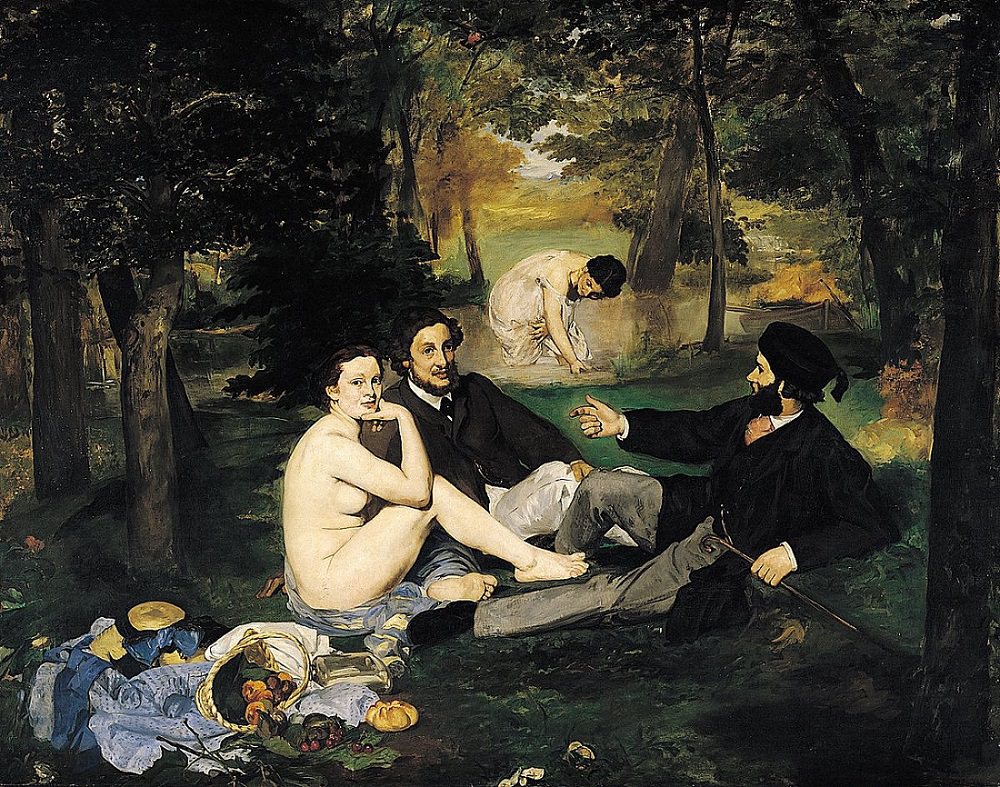
The Luncheon on the Grass, 1862 by Edouard Manet
https://www.manet.org/images/gallery/the-luncheon-on-the-grass.jpg
Before Manet, art was primarily for gods and kings. The hands of the artists who served religious institutions and the court were literally the hands of the gods and the nobility. Manet's hands, however, were different. It changed the art that followed. Here are a few critiques. “Realistic, naturalistic art had dissembled the medium, using art to conceal art; Modernism used art to call attention to art. (omission) Manet's became the first Modernist pictures by the frankness with which they declared the flat surfaces on which they were painted" (Greenberg 1961) [12], “If Manet had lived a little longer, the series of work, even now has not lost its vividness even, makes one wonder if another modern and contemporary art movement might have followed" (Cachin 1994) [13], "it becomes quickly apparent that Manet is unconcerned with creating the illusion of a real-life space, and furthermore, he seems to be in many places trying to purposefully rupture one’s sense of illusion by muddying the relationship between a figure and ground and flattening out parts of the image" (Israel 2014) [14].
In 1863, Manet submitted The Luncheon on the Grass to an exhibition. The "prestigious" Salon de Paris was established in 1648 by the L’Academie royale de peinture et de sculpture in France. However, it was not selected. In the same year, the painting was exhibited at an unsuccessful exhibition organized by the order of Napoleon III, but he was severely criticized. There were two main reasons. First, the work was considered "poorly painted" to begin with. At that time, it was considered important for paintings to be realistic and not to leave brushstrokes. However, as if to expose the deception that "this is not a painting”, Manet's brushstrokes clearly asserted that "this is a painting”. Second, the work was considered a “scandal”. Until then, naked women had been depicted only as mythological or historical themes, and never in the real world as in The Luncheon on the Grass. The location of this painting is a park (Francois Gerard’s painting Psyche and Amor, which was selected for the Salon in 1798, was accepted as a sublime painting that adopted mythology, even though it seems more obscene, vulgar, and inappropriate). The antisociality of doing something dubious outdoors in broad daylight. And disgust (or envy and jealousy toward the urban debauchee?) to Manet, by connecting the eyes of the woman on the left of the painting and the eyes of the viewer, Manet gives people an feeling as if they were also experiencing "the scene”, and makes people imagine "it" even if he or she does not want to. The people were confused and took their confusion out on Manet.
In 1862, Manet told his friend Antonin Proust what could be taken as a criminal warning: "I feel I must paint prostitutes. People will tear me to pieces. But whatever.“ [15] The theme of prostitutes Manet focused on at the time was a dark side of society that should not be ignored. Manet's awareness of the problem is made clear by the pictorial statement, "Look at the reality”. After Manet, "taboo" became one of the conditions of art (and was followed by Van Gogh's "madness," Jean Dubuffet's "outsider," and Richard Hamilton's "pop," the exceptions to art).
Jacques Derrida mentioned in Dissemination like this. [16] “The reason why Plato likens painting to pharmacon is that pharmacon in Greek also means painting. Namely, painting is not a natural color, but a chemical fabric that imitates artificial tones, colors given in things.” Manet's paintings continue to attract people as artificial pharmacon (something both poisonous and medicinal) that are far from mimesis (imitation). Manet is the most important artist in terms of capturing the ARTMIND. Because he has all the fundamentals of the aforementioned ARTMIND. We will look at each ARTMIND through Manet's eyes below.
ARTMIND 1: reversal of good and bad
What is not art becomes art. This is the basis of art history. A structure, something outside of the system becoming embedded within the system, updating and enhancing it, is not limited to art. Just as ex-fraudsters and ex-hackers work as security consultants for the FBI, just as new kinds of terrorist attacks and accidents strengthen security systems and laws, the system is improved by its exceptions and maintains its viability. The exceptions to the 1863 art system were, quite simply, bad things: "to insist on being a painting (to ignore realism and expose its deceptions)" and "to paint a theme that is not sublime (non-idealized reality, prostitutes)." Although he had a few understandable associations with Delacroix, Baudelaire, Mallarme, Monet, and others, many considered Manet "bad art.” But the name of Manet now stands as the foremost example of "good art (it is possible that Manet will become bad art again in another sense, or that now that it has become good art, it is no longer art)”. This reversal of good and evil, "bad art is good art”, often occurs in art history. In a sense that it is a system incorporating the outside, Art is an “exosystem” (ecological system different ftom Bronfenbrenner [17]).
ARTMIND 2: knowing the unknown: awareness of ignorance
Although the unknown confounds and horrifies us, it also holds something that sparks our curiosity and inspires our whole body. Manet opened up the world of the unknown. It is a distortion of space (clearly different when compared to the aforementioned Psyche and Amor). As Francoise Cachin says, "the perspective that has dominated painting since the Renaissance is ignored.” [18] Considering the original title, "Bathing" (retitled “The Luncheon on the Grass" in 1867), we can see that the figure at the back center of the painting was originally important. First of all, this woman is strange. The brushwork in the space around her is “messy". Although the ground behind the woman on the left and the man on the right is connected to the ground, the right side of the painting is more "messy" than the left side. This cluttering occurs in the surroundings of the bathing woman (ground, water, grassland). In contrast, this woman is clearly depicted with the same density as the three in the foreground, even though she is at the far end (if perspective were employed, she would naturally be depicted paler than the three). If one pays attention to these techniques, the bathing woman appears as if she is in a different dimensional space. This intentional distortion is evident in later Cezanne, but Manet already painted another painting within one painting or another reality within one reality. Thus, after Manet, the ARTMIND of "knowing the unknown" became the basis of art (or a traditional value), moving away from the traditional value of repeating myths and history (Although The Luncheon on the Grass references two Renaissance paintings when you compare the two to The Luncheon on the Grass, you will reach further unknown knowledge).
ARTMIND 3: constant transformation
There has been no small number of people, such as Heraclitus and Jonathan Swift, who believed that “something that doesn’t change is to change.” By continually transforming our minds as our environment changes, or by continually changing our environment through the transformation of our minds, humanity has come to this day (it is possible to say that this mindset of constant transformation that brought us stone tools, needles, steam engines, the Internet, etc). Manet brought a change (indifference to traditional values, confronting taboos, crystallizing unprecedented practices of thought and feeling in painting) to long-established conventions. If history had not had Manet, art would still be a painting of angels, and urinals would still be urinals (there may have already been someone like Manet before Manet. There may have already been people like Manet before Manet, who may not have been Homo sapiens, but rather Neanderthal or Paranthropus, or perhaps even not human at all). It is often said that "there is no if in history," but given that history is also in the midst of constant transformation, it can always be overturned, and it can always be changed.
Next, let us look at the ARTMIND from the perspective of ART FOR HUMAN.
[1] Elizabeth Kolbert, The Sixth Extinction: An Unnatural History (New York: Henry Holt and Company, 2014).
[2] [5] Harari, Yuval Noah, 2017 Homo Deus, Vintage
[3] [31] Max Tegmark, LIFE 3.0: being human in the age of Artificial Intelligence (New York: Knopf, 2017).
[4] Virilio, Paul 2002 Ce qui arrive, GaliLee
[6] [44] Harari, Yuval Noah, 2017 Homo Sapiens, Vintage
[7] http://pinnaclepointestate.co.za/caves/
[8] https://www.nytimes.com/2017/07/19/science/humans-reached-australia-aboriginal-65000-years.html
[9] http://www.anthropocene.info/great-acceleration.php
[10] Lyotard, Jean-Francois 1979 The Postmodern Condition, Les Editions de Minuit
[11] Grant Pooke and Graham Whitham, art history, teach yourself (London: Hodder Education, 2003).
[12] http://www.sharecom.ca/greenberg/modernism.html
[13] [18] Cachin, Francoise 1984 Manet, 1832-1883 Harry N Abrams Inc
[14] https://www.artsy.net/article/matthew-the-first-modern-painting
[15] Courthion, Pierre 1961 Manet, Harry N. Abrams, Inc
[16] Derrida, Jacques 1972 Dissemination The University of Chicago Press
[17] Urie Bronfenbrenner, The Ecology of Human Development: Experiments by Nature and Design (Cambridge, MA: Harvard University Press, 1979).
2.What is ART FOR HUMAN?
Introduction